
At SDS RiskAssist, we often hear from occupational health and safety professionals – whether they work in hospitals, manufacturing facilities, laboratories or colleges – searching for answers about potential chemical hazards in their workplace that may affect an employee's reproductive health, fertility or unborn child. The conversation typically goes like this:
“An employee just told me they’re pregnant. They want to know if there's anything in the workplace that could harm their unborn child. How do I quickly identify which chemical products may be hazardous to their baby?”
It is a simple question. But in a workplace with hundreds or even thousands of chemical products, finding the answer can be anything but simple.
Imagine having 500 chemical products in use and three binders full of Safety Data Sheets.
Now imagine trying to determine which products could pose a reproductive, developmental or genetic hazard, and doing it quickly enough to make informed, timely decisions about the employee's work.
It can feel impossible.
Recently, I spoke to the employee responsible for a client's pathology lab. I showed her how quickly she could identify products with hazards for fertility and unborn children.
She almost cried.
“Oh my god, you are an angel,” she said. “I can't believe I can have this at my fingertips.”
That reaction stayed with me because it illustrates just how important this information is.
Knowing whether a chemical could affect an employee's fertility, pregnancy or child should not feel like a privilege. Employers have a responsibility and workers have a right to know and act on this information to safeguard parent and child.
Reproductive health risks can extend far beyond immediate chemical exposure
Chemical hazards aren't always about an employee becoming sick immediately after an exposure. There may be no immediate response to an exposure. The effects may not become apparent until much later. Previous incidents may not even be recognized as being connected to the workplace.
Types of reproductive health risks from chemical hazards
Some chemicals are classified as germ cell mutagens, meaning they can cause permanent changes to the DNA of reproductive cells – sperm or egg cells. Similar to X-rays, they typically do not affect the person exposed, but they can have a significant impact on their future children that can be carried through future generations.
Other chemicals can cause reproductive toxicity, affecting fertility or sexual function, or developmental toxicity, potentially harming an embryo or fetus.
Some chemicals can also pose a risk to a breastfed child.
All of these potential impacts make prevention particularly important.
If a child becomes seriously ill because of a parent's exposure to a hazardous substance, the consequences can extend for a lifetime. Preventing the exposure in the first place can be enormously impactful, not only for the worker, but for their family and future generations.
An increasingly important public health issue
Health Canada recognizes that some populations can be more susceptible to the impacts of chemical substances.
Since 2007, Health Canada scientists have been conducting the Maternal-Infant Research on Environmental Chemicals (MIREC) study on the possible health effects of environmental chemicals on mothers and their children during pregnancy and throughout childhood development.
The MIREC Research Platform, part of Canada's Chemical Management Plan, includes the original study and a series of follow up studies on prenatal exposure to environmental chemicals, including metals, pesticides, flame retardants, surfactants and other industrial chemicals.
Another federal government initiative, the Chemicals Management Plan Engagement and Outreach Contribution Program specifically targets pregnant people, infants and children, and youth as priority populations whose life stages can make them more susceptible to the impacts of chemicals. The program is intended, among other things, to increase knowledge about chemicals, their effects on human health and ways to reduce risks.
That focus sends an important message to workplaces:
We need better ways of understanding and managing chemical hazards before they result in harm.
And that includes reproductive and developmental hazards.
The goal isn't to create fear around chemicals.
The goal is to understand the hazard and manage the risk.
Do any of the chemicals we use pose reproductive or developmental hazards?
When people ask this question about reproductive or developmental hazards, they may picture highly specialized industrial chemicals.
But potentially problematic products can be found in many homes and ordinary workplace environments, including:
- Paints and spray paints
- Solvents and maintenance chemicals
- Paint removers
- High-strength adhesives
- Carburetor cleaners
- Windshield washer fluid
- Housekeeping products
- Metal and stainless-steel cleaners
- Resins and additives
- Metal-cutting fluids
Knowing if a chemical could affect your fertility, your pregnancy or your child should not feel like a privilege. Employees have a right to access this information.
WHMIS hazard statements related to fertility, pregnancy and child development risks include:
- “May damage fertility or the unborn child” – indicating the chemical is known or presumed to cause reproductive toxicity.
- “Suspected of damaging fertility or the unborn child” – indicating suspected reproductive toxicity.
- “May cause genetic defects” – indicating the chemical is known or presumed to cause genetic defects.
- “Suspected of causing genetic defects” – indicating suspected genetic toxicity.
- “May cause harm to breast-fed children” – indicating a hazard that can potentially be passed to a breastfed child.
These aren't hazards that should be buried somewhere in a 20-page SDS and forgotten.
They need to be visible and actionable.
What about paternal exposure to chemical hazards?
Protecting reproductive health isn't only a pregnancy issue, and it isn't only a women's health issue.
Workers in their reproductive years, both men and women, should understand that some workplace chemicals can affect reproductive organs, fertility, sperm quality and other aspects of reproductive health.
There is also emerging evidence worth paying attention to regarding paternal occupational exposures.
For example, a recent Danish nationwide population-based case-control study reported an association between paternal occupational exposure to hydrocarbon solvents, including toluene, during the period from three months before conception through birth and certain cancers in offspring under age 20.
The findings don't mean that every exposure will result in harm. But they reinforce why understanding reproductive hazards and controlling workplace exposures matters – not only for today's worker, but potentially for their future children.
What employers can do to safeguard employee reproductive health
The good news is that organizations don't have to reinvent their entire chemical safety program.
Many already have established procedures for particularly sensitive hazards; for example, radiation safety protocols or procedures for workers handling hazardous drugs.
Reproductive and developmental hazards deserve the same kind of systematic attention.
In some circumstances, the appropriate solution may be a temporary accommodation during pregnancy – just as a pregnant employee might be temporarily reassigned from operating an X-ray machine.
When a potentially hazardous product is identified, I recommend starting with five questions:
1. Why are we using this product?
What function does it serve? Is it a bathroom cleaner, adhesive, paint, degreaser or maintenance chemical?
Understanding the purpose helps you determine whether substitution is possible.
2. Where is the product being used?
Who works in that area? Could other employees be exposed? Are there people who may be particularly sensitive to the hazard?
3. How frequently is the product used?
Is it being used several times a day, every day? Or once a year?
Frequency and duration are important parts of understanding exposure.
4. Can the product be eliminated or substituted?
Look for safer alternatives. If another product can accomplish the same task without the same reproductive, developmental or genetic hazard, substitution is the best solution.
5. What is the risk? Assess and control it.
Finally, if the product can't be eliminated or replaced, conduct a risk assessment, considering who will use the product as well as who else may be exposed, and determine appropriate controls.
Depending on the situation, controls could include engineering controls, ventilation, changes to work practices, personal protective equipment (PPE), exposure monitoring or temporary reassignment.
The important thing is to make the decision based on the actual risk versus only the hazard.
Making fertility and reproductive information accessible
This is one of the reasons we built SDS RiskAssist for OHS leaders – and employees.
When a client administrator logs into the SDS RiskAssist platform, they can select Assess Hazards - WHMIS and then choose the Parent/Child control type.
The system immediately identifies chemical products in their inventory with WHMIS hazard classifications related to:
- Reproductive toxicity
- Developmental toxicity
- Germ cell mutagenicity
- Other hazards affecting fertility, pregnancy, breastfeeding or future generations
The information is presented along with the applicable signal word, such as Danger or Warning:
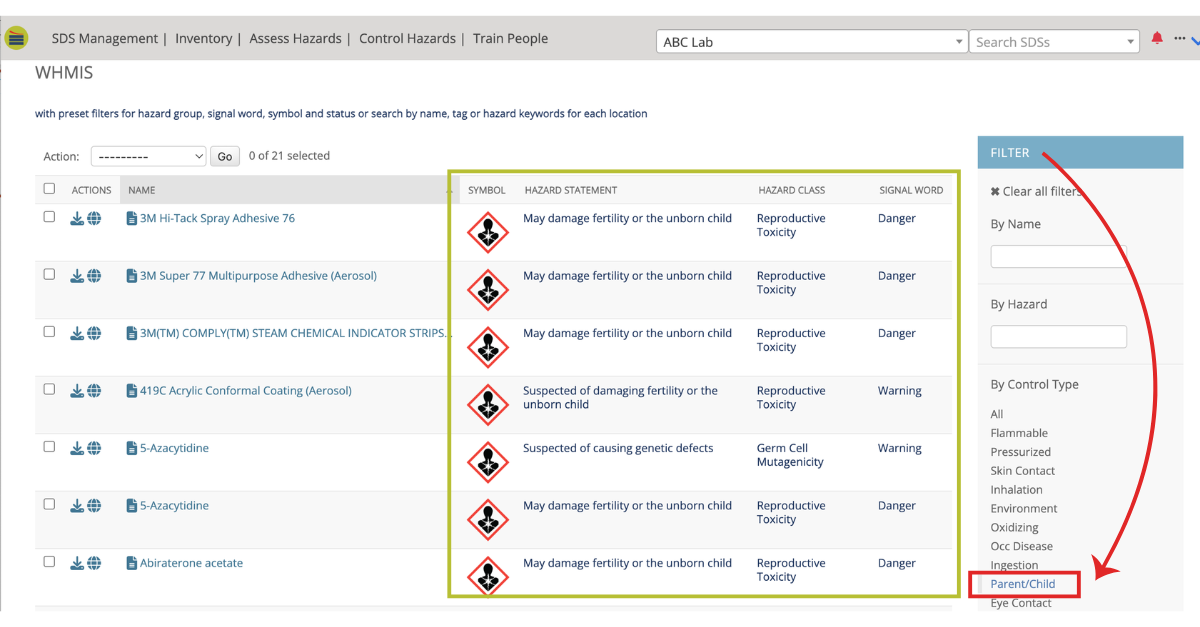
Once a hazard has been identified, the administrator can move into Control Hazards to review existing controls or search for potentially safer chemical alternatives.
That changes the conversation.
Instead of an OHS professional saying, “I need to go through 1,000 SDSs and figure this out,” they can quickly answer:
- Which products do we need to look at?
Then the more important questions can begin:
- How is this product being used?
- Who could be exposed?
- Can we eliminate or substitute it?
- What controls are needed?
- Does this employee need to be temporarily reassigned?
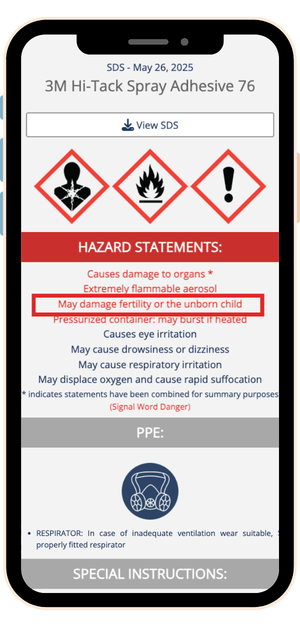
SDS RiskAssist also makes dense SDS information readily accessible to employees through SafetySnap™ summaries that translate WHMIS hazard information into clear, simple language. For example:
PARENT/CHILD HAZARD: Exposure to this product could result in genetic defects - permanent changes to body cells that can be passed onto future generations.
Information for better conversations about reproductive health in the workplace
Ultimately, chemical safety isn't about creating unnecessary fear or telling workers that they can't use certain products.
It's about giving employers and employees the information they need to make good decisions to protect reproductive health.
An employee should be able to say:
“I'm using this product in my workflow. What risk does it present to me? What risk could it present to my fertility or my child?”
And the employer should be able to provide the facts.
That conversation shouldn't depend on someone having the time to manually search through hundreds of Safety Data Sheets.
The information should be accessible before an exposure occurs – not after.
Because when it comes to reproductive health, pregnancy and the health of future generations, prevention matters.
We have an opportunity to identify these hazards, eliminate them where possible, control them when necessary, and prevent needless harm.
It's a responsibility that every employer bears, and getting it right can make all the difference for the families involved.
Please reach out with any questions.
— Lisa Hallsworth
CEO, SDS RiskAssist
Note: Chemical hazard classifications and workplace risks need to be evaluated in the context of the specific product, concentration, route and duration of exposure, and how the product is used. SDS information is an important starting point, but it does not replace a workplace-specific risk assessment or appropriate occupational health advice.