
Updated: March 2026
Welcome to our comprehensive guide to WHMIS symbols and meanings! In any workplace setting, safety is your top priority. Whether you work for a municipality, or in a school, laboratory, office or manufacturing plant, it's essential to understand workplace hazards to keep yourself and your coworkers safe. Effective hazard communication is one of the key aspects of ensuring a safe working environment. That's where WHMIS symbols come into play.
WHMIS, which stands for Workplace Hazardous Materials Information System, is Canada's standardized system to label and communicate information about hazardous materials. It is based on the United Nations Globally Harmonized System of Classification and Labelling of Chemicals, known as UN GHS or simply GHS. The GHS has been adopted in 72 countries around the world.
An important aspect of WHMIS is the black pictograms within the distinctive red diamonds. These symbols serve as visual representations of the potential hazards associated with certain substances. They help workers quickly see that there may be risks involved with handling the products. However, understanding all the risks can be a daunting task.
That's why we've created this guide to help you quickly understand the meanings behind these safety symbols and empower you to promote a safer and more informed workplace. So, let's dive in and review WHMIS symbols together!
Why is it important to understand WHMIS symbols in the workplace?
Understanding WHMIS symbols is crucial to maintain a safe working environment. In fact, SDS RiskAssist data shows that the average workplace uses 70 hazardous chemical products!
The many potentially hazardous substances that are commonly found in the workplace include chemical ingredients in cleaning agents, solvents, gases and more. Chemical products are in use in all workplaces, including schools, municipal facilities, manufacturing plants, dentist's offices, laboratories, and healthcare and hospitality facilities.
It's also important to note that in Canada, occupational health and safety legislation requires employers to take "all reasonable precautions" to ensure their workplace is safe. Employers must:
- identify and properly label all hazardous products on site
- keep safety data sheets up to date and accessible, and
- provide education and training on the hazards and safe use of products
WHMIS symbols enable employees to easily identify these hazardous materials. They signal the need to take appropriate precautions to minimize the risk of health hazards, such as toxicity, and physical hazards, such as flammable materials. This knowledge is the first step to understanding how to handle and store hazardous materials safely to protect yourself and your colleagues from harm.
A solid understanding of WHMIS symbols empowers everyone on your team to make informed decisions and reduce the risk of accidents and injuries. This creates a culture of safety.
Types of WHMIS symbols and their meanings
WHMIS symbols are standardized pictograms that represent specific types of hazards. There are a total of nine GHS-aligned symbols with the characteristic red diamond. There's also one all-black, round pictogram for biohazards, retained in Canada from Canada’s original WHMIS system. WHMIS defines hazards in two classes: Physical Hazards and Health Hazards, with a third class related to Environmental Hazards, which is optional in Canada. Understanding these symbols and their meanings will help you identify and respond to potential hazards effectively.
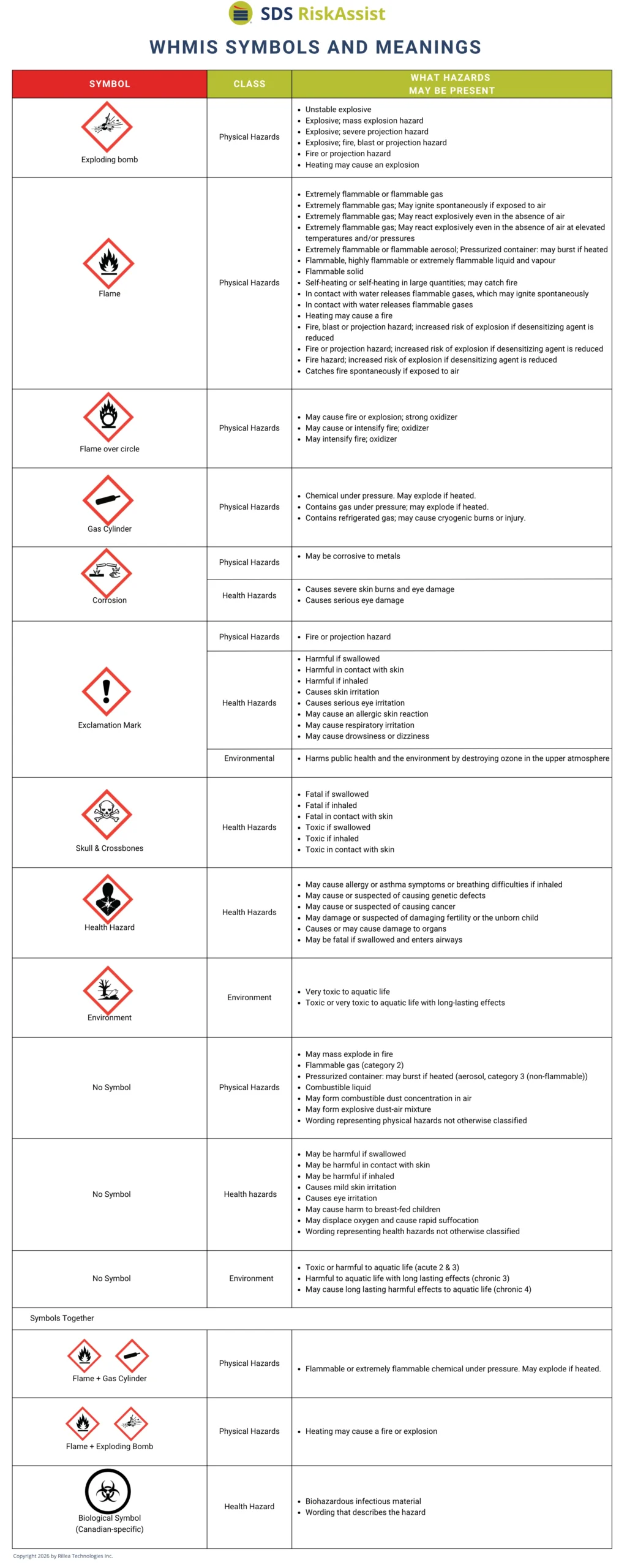
Pro tip: SDS RiskAssist software enables occupational health and safety officers to easily flag and sort all chemical products used in your workplace by their WHMIS hazard symbols
How to use WHMIS symbols effectively
WHMIS symbols provide valuable information about the hazards of chemical products in the workplace. They are designed to catch people's attention and visually warn them of danger.
In addition to knowing what WHMIS symbols mean, it is important for employees to look for the associated hazard statement. Hazard statements are brief, clear, standardized sentences that describe the most significant hazards of the product. Examples of hazard statements are: "fatal if inhaled" and "may cause cancer."
In addition to the WHMIS symbols and hazard statements, it is essential to consult the Safety Data Sheet (SDS) for detailed information about the hazardous material. The SDS provides comprehensive information about the substance's properties, handling procedures, storage requirements and emergency response measures.
Pro tip: You can use SDS RiskAssist software to add your own site-specific, customized safety procedures for hazardous chemical products. These customized instructions are included in our convenient SafetySnap one-page SDS summaries, which make it easy for employees to understand safe handling procedures at a glance.
WHMIS training and education for employees
Providing comprehensive WHMIS training and education for employees is another important pillar of workplace safety and compliance with safety regulations. By investing in employee training, you can empower your team to understand and interpret WHMIS symbols effectively. This reduces the risk of accidents and injuries.
Pro tip: SDS RiskAssist technology helps employers meet WHMIS’s site- and job-specific training requirements with on-demand micro-training modules that address the most common hazards in your workplace, as determined by our software.
WHMIS training should be an ongoing process. This commitment to continuous education will help maintain a culture of safety and ensure that employees remain knowledgeable and prepared to handle potential hazards effectively.
Finally, promoting open communication and reporting of potential hazards will further ingrain your safety culture. Encourage employees to report any concerns or incidents related to hazardous materials and WHMIS symbols, and provide a clear process for addressing these issues promptly to create a safer working environment for everyone.
Common misconceptions about WHMIS symbols
Although WHMIS symbols are designed to provide clear and concise information about potential hazards, there are common misconceptions that can lead to confusion or misinterpretation. Addressing these misconceptions is important to ensure the effective use and understanding of WHMIS symbols.
One common misconception is that WHMIS symbols alone provide sufficient information about the hazards associated with a substance. As discussed above, while WHMIS symbols are an essential component of hazard communication, they should be used in conjunction with other sources of information, such as Safety Data Sheets (SDS) and workplace-specific protocols. These additional resources provide more detailed information about the specific risks and precautions associated with a substance.
Another common misunderstanding is that Canadian suppliers are required to classify and disclose environmental hazards (such as "Hazardous to the Aquatic Environment") on a Safety Data Sheet. In reality, the Hazardous Products Regulations (HPR), which govern WHMIS, only mandate the disclosure of physical and health hazards. Because WHMIS is strictly a workplace safety system, environmental risks are considered outside its scope and fall under different legislation, such as the Canadian Environmental Protection Act (CEPA). While you may often see the "Environment" pictogram (a dead fish and tree) on SDSs—especially those coming from the U.S. or Europe—its use in Canada is entirely voluntary. Suppliers are permitted to include it, but they are not legally required to do so under WHMIS.
Additionally, some individuals may mistakenly believe that WHMIS symbols are only relevant to those directly handling hazardous materials. In reality, WHMIS symbols are important for all employees, as they provide valuable information about potential risks and the necessary precautions to take. Even if you do not directly work with hazardous materials, understanding WHMIS symbols can help you recognize and respond to potential hazards in your environment.
Lastly, there is a misconception that once you have learned the meanings behind WHMIS symbols, there is no need for further education or training. However, WHMIS symbols and safety regulations can evolve over time. It is essential to stay up to date with any changes and participate in ongoing training and education to ensure that you are well-informed and prepared to handle potential hazards effectively.
By addressing these common misconceptions, you can promote a more accurate understanding of WHMIS symbols and their use.
Updates and changes to WHMIS symbols
WHMIS symbols, like many other safety standards, are subject to periodic updates and changes to reflect new knowledge and technology. Staying informed about these updates is crucial for maintaining compliance with safety regulations and promoting a safe working environment.
In December 2022, Canada's federal Hazardous Products Act and Hazardous Products Regulations (HPR) introduced changes that affect some WHMIS symbols. Suppliers had a three-year transition period (to December 14, 2025) to bring product classifications, safety data sheets and labels into compliance with the amendments. The most notable impact has been on:
- Aerosols: Changed from "Flammable Aerosols" and now includes a non-flammable category (category 3).
- Chemicals Under Pressure: A brand new hazard class - look for the Flame and Cylinder symbols together.
- Flammable Gases: Better sub-categorization for pyrophoric and chemically unstable gases.
- Combustible Dust: Look for the new, clearer hazard statement "May form explosible dust-air mixture."
Pro tip: Many clients have used SDS RiskAssist to print new, compliant workplace labels, to update the information on older containers.
Another recent change is that in 2023, the Government of Canada amended the Canadian Environmental Protection Act (CEPA) to recognize the right of all individuals in Canada to a healthy environment. The CEPA amendment also has implications for employers, and this is where the WHMIS SDSs can play another critical role.
Under CEPA, the Government of Canada has stronger enforcement tools than occupational health and safety legislation. Now, not only is managing chemical safety the right thing to ensure healthy work environments for employees, but not doing so can be very costly to brands, both in fines and reputation.
To stay updated on changes to WHMIS symbols, regularly consult official sources such as the Canadian Centre for Occupational Health and Safety, which provides information and resources related to WHMIS. These sources will provide detailed information about any updates, changes, or new symbols introduced to the system.
FAQs
Are environmental hazard symbols mandatory in Canada?
No. Environmental hazard classification is not mandatory under the Canadian Hazardous Products Regulations (WHMIS). While the symbol may appear on some SDSs, its use is voluntary in Canada as environmental oversight falls under different legislation like CEPA.
What is the new WHMIS hazard class for chemicals under pressure?
The 'Chemicals Under Pressure' hazard class was introduced in the WHMIS 2022 update. It identifies liquids or solids under pressure in containers other than aerosols. The flammable categories (1 and 2) require both the Flame and Gas Cylinder pictograms while category 3 (non-flammable) only requires the Gas Cylinder Pictogram.
Is the 2025 WHMIS transition deadline still in effect?
The transition period for the Amended Hazardous Products Regulations officially ended on December 14, 2025. All SDSs and labels in Canadian workplaces must now be fully compliant with the WHMIS 2022 standards.
What is the new combustible dust hazard statement?
The new combustible dust hazard statement is "May form explosible dust-air mixture".
Is 'WHMIS 2015' still the official name of the system defined by the Canadian Hazardous Products Regulation?
No, Health Canada as dropped the year and simply refers to the system as WHMIS.
What happens if I still have products with WHMIS 2015 labels in my workplace?
As of December 15th, 2025, all hazardous products sold, imported or used in Canada must be compliant with the new regulations. If you have an old product in your workplace and you use SDS RiskAssist, you can print a new workplace label based on the updated SDS.
What actually changed in Section 9 of the SDS?
Section 9 underwent several changes.
New elements:
- Particle characteristics for combustible dust hazards.
Removed elements:
- Odour threshold and Evaporation rate.
Adjusted elements:
- Physical state and Colour are now standalone requirements
- Boiling point description changed
- Flammability now includes liquids as well as gases and solids
- Viscosity is now 'kinematic viscosity'
- Vapour density is now 'relative vapour density'
- Relative density is now 'density and relative density'
Do I need to retrain my employees if they are already trained on WHMIS 2015?
Yes. According to occupational health and safety regulations, employers must provide training and periodic refresher training for employees to ensure they understand and can recognize all WHMIS hazards.
Can I use a US SDS for a product used in a Canadian workplace?
Not necessarily. While both Canada (WHMIS) and the US (HazCom) are transitioning to align with GHS Revision 7, Canada has completed the transition period at the date of this blog but the US has not. Manufacturers, importers and distributors of substances have until May 19, 2026, to comply with the updates and the compliance date for mixtures is November 19, 2027. In addition, Canadian SDSs are required to be available in both English and French, Canada has stricter rules regarding the disclosure of hazardous ingredients and concentration ranges when protecting 'Confidential Business Information' and the SDS must list the name, address and telephone number of the Canadian manufacturer or importer.
Disclaimer: Although every effort is made to ensure the accuracy, currency and completeness of the information, SDS RiskAssist does not guarantee, warrant, represent or undertake that the information provided is correct, accurate or current. SDS RiskAssist is not liable for any loss, claim, or demand arising directly or indirectly from any use or reliance upon the information.