Reducing PFAS risks in the workplace
Perfluorinated and polyfluorinated alkyl substances (PFAS) are coming under increasing scrutiny and regulation in Canada due to their impacts on human and environmental health.
Below we explain what these chemical substances are, what types of products PFAS are found in, how they affect human health, how they are regulated in Canada, and how to identify products containing PFAS in your workplace.
What are per- and polyfluoroalkyl substances (PFAS)?
Per- and polyfluoroalkyl substances (PFAS) are a large group of human-made chemicals that are widely used as coatings, detergents, lubricants, and stain or liquid repellants in a variety of consumer products and industrial applications since the 1950s.
PFAS are known as ‘forever chemicals” as they are extremely slow to break down and therefore have long-lasting effects on the environment. As a result, they can accumulate in natural resources such as drinking water, soil, and air, and also be found in household dust and food, leading to potential long-term human and environmental exposure.
According to Public Health Ontario, all Canadians are exposed to some PFAS and population-based biomonitoring data are available via the Canadian Health Measures Survey.
What types of products contain PFAS?
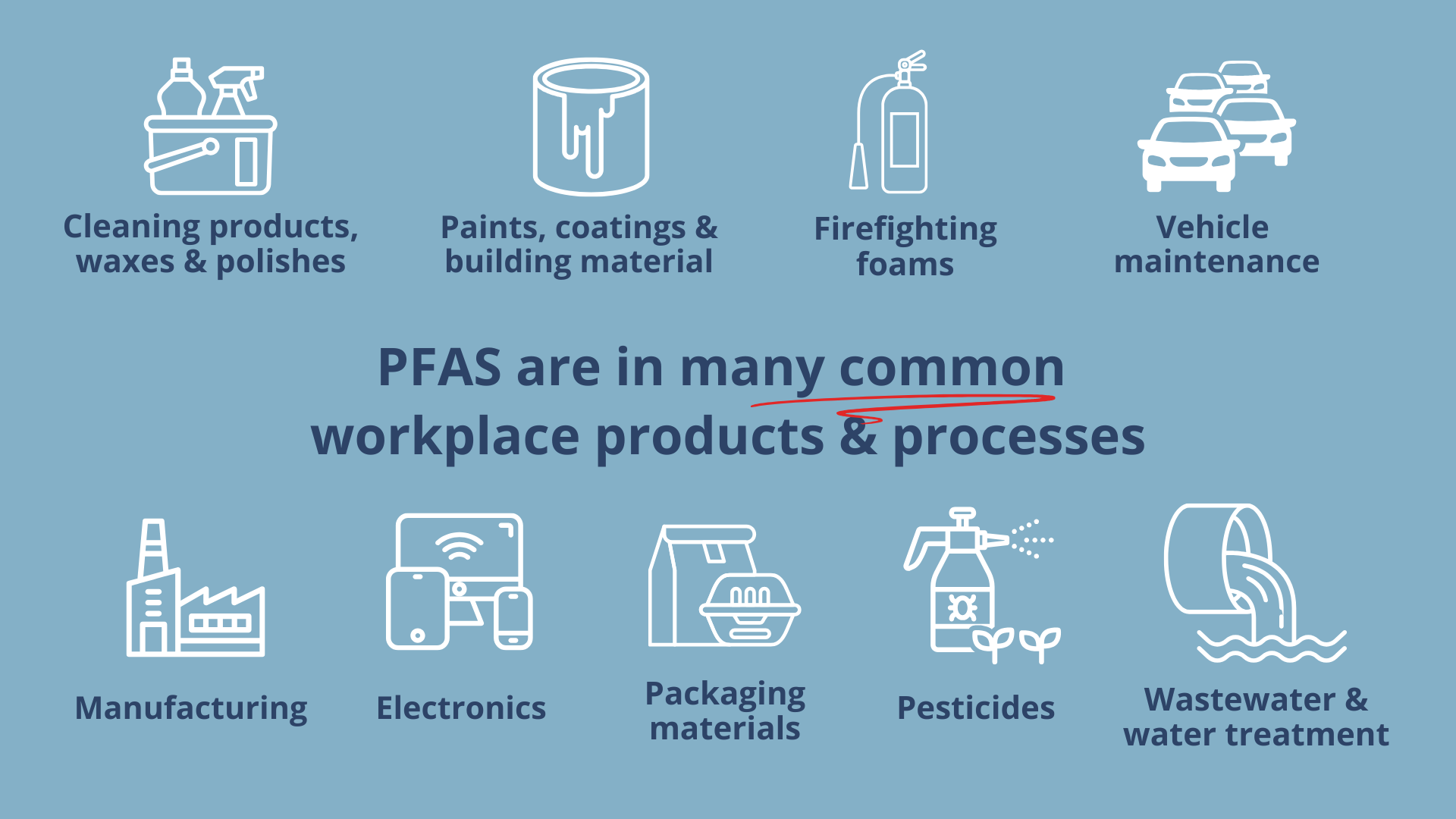
Their high resiliency to heat, physical and chemical damage as well as dirt, oil and water repellency, make PFAS very attractive for products such as:
- Firefighting foams
- Cardboard coatings
- Outdoor equipment
- Cookware
- Food packaging materials
- Drugs (including natural health products and non-prescription drugs)
- Medical devices
- Cosmetics
- Pesticides
- Fabrics (carpets, furniture and clothing)
- Vehicles
- Electronics
- Paints, coatings and building materials
- Cleaning products, waxes and polishes
- Plastics and metal production
How PFAS affect human and environmental health
PFAS are well absorbed by humans but poorly eliminated, meaning that they can accumulate in our bodies over time. Animal based studies have found that high levels are associated with health effects, impacting:
- the liver, kidney and thyroid
- metabolism and body weight
- immune and nervous systems
- development and reproductive system
PFAS are also of concern due to how they persist in the environment, contaminating drinking water sources and affecting the health of wildlife.
PFAS regulation in Canada
Canada is a world leader in action against PFAS and other toxic chemicals.
In March 2025, the Government of Canada published the State of Per- and Polyfluoroalkyl Substances (PFAS) Report, which concludes that the class of PFAS, excluding fluoropolymers, is harmful to human health and the environment.
The government also announced several steps to address PFAS risks “to prioritize the protection of health and the environment while considering factors such as the availability of alternatives.”
This includes a proposal to add the class of PFAS, excluding fluoropolymers, to Part 2 of Schedule 1 to the Canadian Environmental Protection Act, 1999 (CEPA).
Note that when chemicals are added to Schedule 1, the Government of Canada is signalling to Canadians that they are considered toxic. When they are added to Part 2 of the Schedule, the priority is pollution prevention (CEPA, Part 2, paragraph 11.)
The important step of adding the chemicals to Schedule 1 is that it enables the Government to take legal action on these chemicals.
The proposed pollution prevention action priorities will be in 3 phases:
- Phase 1: Address PFAS in firefighting foams (not currently regulated), due to high potential for environmental and human exposure
- Phase 2: Address the uses of PFAS in consumer products where alternatives exist, such as certain textiles, ski waxes, building materials, and food packaging materials
- Phase 3: Evaluate sectors requiring further consideration through stakeholder engagement and further assessments
Learn more about CEPA and its Right to a Healthy Environment provisions.
Prohibition of Certain Toxic Substances Regulations, 2025
Other Canadian regulations expand controls over substances listed on Schedule 1 of CEPA, including several PFAS and other high-concern chemicals — with direct impacts on products, formulations, imports and laboratory use.
The Prohibition of Certain Toxic Substances Regulations, 2025 (the 2025 Regulations) was published in Canada Gazette, Part II on Dec. 31, 2025. The 2025 Regulations will repeal and replace the Prohibition of Certain Toxic Substances Regulations, 2012 (the 2012 Regulations) when they come into force on June 30, 2026.
The 2025 Regulations enable the Government to take enforceable action on substances listed in Schedule 1 of CEPA, to manage risk to people and the environment. As a result, it's important for employers to understand whether they manufacture, use or import products that contain these ingredients.
See the list of substances subject to the 2025 regulations.
PFAS Reporting Requirements
As part of the Government of Canada's PFAS initiatives, 163 PFAS were added to the National Pollutant Release Inventory (Part 1C) in 2025 to enhance understanding of their use and impacts.
Any organization that employs more than 10 full-time employees and uses PFAS listed in Part 1C above the minimum reporting level ("a concentration equal to or greater than 0.1% by weight and in a quantity of 1 kilogram or more") is required to report to the NPRI.
NPRI fact sheet: Is your facility required to report to NPRI?
"This data will improve understanding of how PFAS are used in Canada, help evaluate possible industrial PFAS contamination, and support efforts to reduce environmental and human exposure to harmful substances,” according to a press release issued March 5.
The government is also compiling responses received from manufacturers that were required to report in early 2025 on quantities of 312 PFAS manufactured, imported, used, or exported in the 2023 calendar year that met certain thresholds. This work aims to establish baseline commercial use data to support future activities related to the PFAS.
Reporting requirements for labs
Reporting requirements for listed toxic substances, and products containing them, that are to be used in a laboratory for analysis, in scientific research, or as a laboratory analytical standard will be maintained under the 2025 Regulations.
Users of any listed toxic substance, or a product containing it, for the above purposes, are now required to report its planned use through ECCC’s Regulatory Services Platform.
Specifically, "If you are a user of any listed toxic substance, or product containing it, for the above purposes, you are required to report the information set out in the Regulations using ECCC's Regulatory Services Platform before the use of more than 10 grams of each substance each calendar year."
For further information regarding the 2025 Regulations, please visit the webpage Prohibition of Certain Toxic Substances Regulations, 2025: overview.
PFAS in drinking water
The government has also developed an objective of 30 nanograms per litre (ng/L) for a sum of 25 specific PFAS measured in drinking water.
To help accomplish this, “In June 2024, the Canadian Food Inspection Agency published an interim standard to limit the amount of PFAS in biosolids sold or imported as fertilizers. All domestic and imported biosolids intended for use as commercial fertilizers must have less than 50 parts per billion of perflurooctanesulfonic acid (PFOS), a chemical in the PFAS class,” according to a backgrounder from Environment and Climate Change Canada.
PFAS have been found in drinking water across Canada. In North Bay, a proposed class action lawsuit seeks compensation for land owners that allege their private wells are contaminated by PFAS emanating from Canadian Forces Base 22 Wing North Bay and Jack Garland Airport.
The Department of National Defence (DND) has announced a total of approximately $120 million in funding for remediation to address the presence of PFAS near 22 Wing/Canadian Forces Base (CFB) North Bay.
Also see the Government of Canada document: Objective for Canadian drinking water quality- per- and polyfluoroalkyl substances.
Controlling and preventing PFAS exposures
The first step to controlling and preventing PFAS exposures is to identify products containing them.
That can be a difficult task given that there are thousands of PFAS substances in existence.
Since the current NPRI reporting threshold is very low, you’d need to cross reference all the chemicals listed in Part 1C against all the ingredients in Section 3 of your safety data sheets for every chemical product you use.
Pinpoint PFAS products with SDS RiskAssist
Fortunately, there is a far easier, more effective way to identify products containing PFAS in the workplace: subscribers to SDS RiskAssist’s SDS management platform simply access the ‘Assess Hazards’ tools and click on our new NPRI Part 1C - Per- and polyfluoroalkyl substances (PFAS) group or on our general PFAS/PFCs groupto instantly see which products in your chemical collection have PFAS (or PFCS) ingredients.
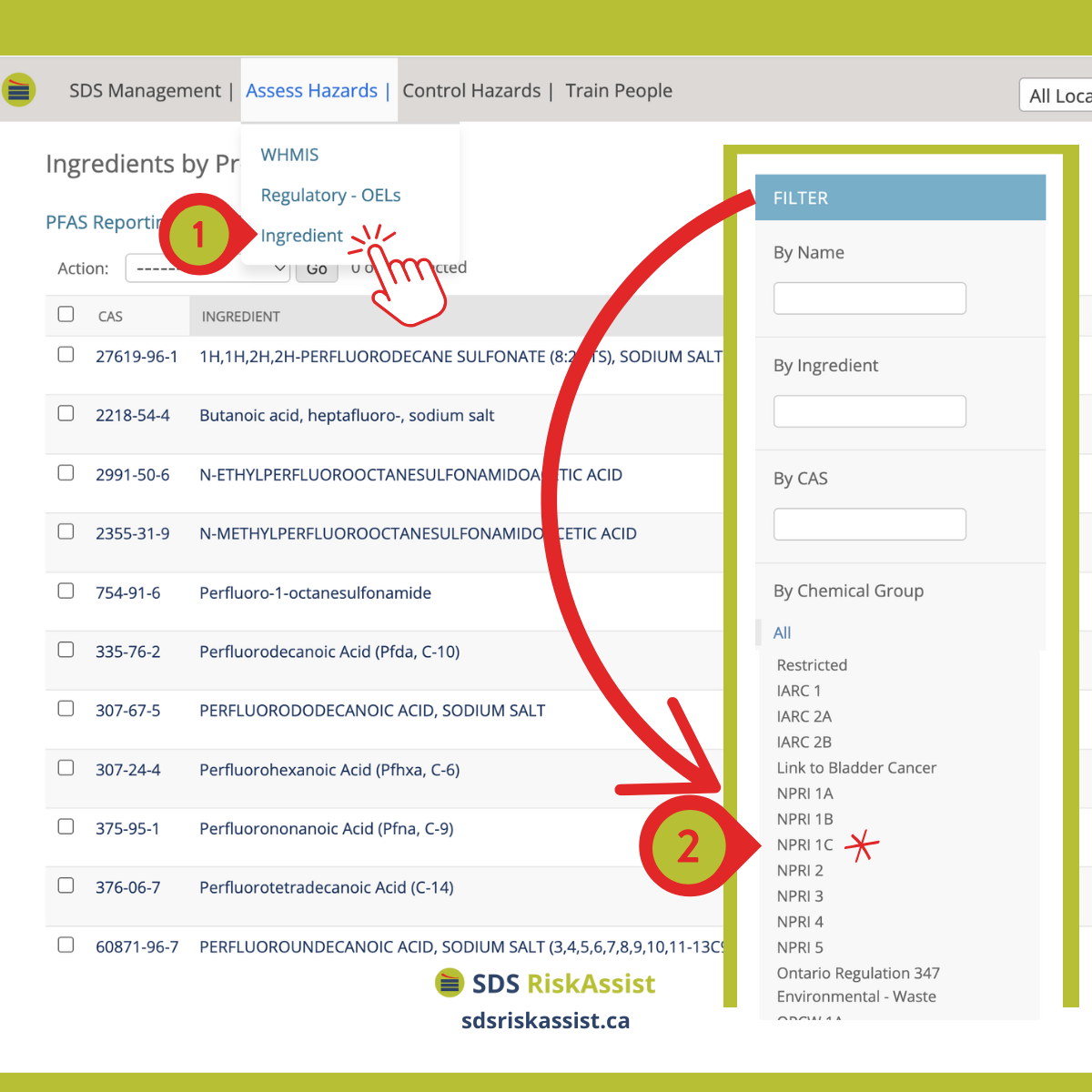
One manufacturer's experience
Just ask our client Belleville’s GH Manufacturing. One of their customers, a global consumer packaged goods company, recently requested PFAS reporting and compliance from their organization. GH quickly got in touch with SDS RiskAssist for support, and we activated the tool in their account.
“SDS RiskAssist quickly identified any PFAS exposure in our operations. We were able to ensure compliance and confidently respond to our customer. The platform has proven itself once again as an essential tool for success in today’s complex regulatory environment.”
— Kim Egan, Executive VP and CFO of GH Manufacturing
Additional identification and compliance reporting tools
Our NPRI Part 1C and general PFAS groups are two of more than 70 chemical groups built into our SDS software to make it easy for you to identify high-risk products and compliance reporting. Our lists also include:
- Asthmagens
- Substances known to cause allergic contact dermatitis
- Common chemical reactions
- Greenhouse gases
- Volatile organic compounds, etc.
- Prohibition of Certain Toxic Substances Regulation list - Canadian regulation - 213 ingredients that are restricted for manufacturing and importing, and have strict reporting requirements
- National pollutant release inventory index list (7 parts), and more.
- Customized lists that are client-specific (i.e., prohibited substances on site)
If you need help with PFAS reporting or other hazard identification challenges, please contact us.